


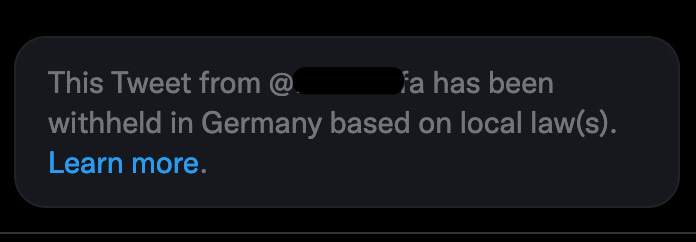
In a rather instructive turn of events, Twitter has decided to withhold one of my tweets in Germany — reportedly the entire account — on the grounds of alleged hate speech and unconstitutional content under the German law (§§ 86, 86a, 130 StGB).
The offending message?
Three words: “heteros are bizarre!” as a reaction to a tabloid’s headline on anal sex.
According to Twitter’s notification, this phrase was deemed serious enough to trigger Germany’s legal framework on hate speech — legislation originally designed to address incitement, extremist propaganda, and violence.
Here is the message Twitter sent:
Hello, We have received a complaint regarding your account, [redacted], for the following content: Content ID: [redacted] Reported Content: Heten sind bizarr! [url] Reported Content URL:
In accordance with applicable law and our policies, Twitter is now withholding your account in Germany, specifically for sections of German law related to hate speech or unconstitutional content, §§ 86, 86a 130 StGB. For more information on our Country Withheld Content policy, please see this page: https://support.twitter.com/articles/20169222. Sincerely, Twitter
For users in Germany, the tweet itself is no longer visible — replaced instead with a withholding notice citing national law.
Context, apparently required
The comment was made in response to a tweet circulating a Bild tabloid image with the headline:
“Addressing a taboo: How do I tell my wife that I fantasise about ‘Po-Sex’?”
(For non-German readers: Po is colloquial slang for “butt.”)
The user sharing the image added the helpful advice:
“Kindly meant tip: don’t call it Po-Sex.”
My contribution to this rich sociological exchange was a brief, weary observation:
“heteros are bizarre!”
This, it seems, was a step too far.
A curious interpretation of harm
What makes the incident noteworthy is not that content moderation exists. But how selectively it appears to function.
German Twitter is, by most accounts, saturated with racist abuse, anti-Blackness, Islamophobia, transphobia, and explicit calls for exclusion or harm against migrants, queer people, and other marginalised groups. Reports against such content are frequently met with silence, boilerplate replies, or the familiar conclusion that the content “does not violate our rules.”
Yet a mildly sarcastic generalisation about a socially dominant, legally protected, and structurally non-vulnerable group is apparently sufficient to activate some of the strictest provisions of German criminal law… at least in platform form.
One cannot help but admire the efficiency.
Protecting the majority, perfectly on time
There is something almost touching about the speed with which offence is recognised when it concerns those not at risk. No slur was used. No call to violence was made. No group historically subjected to persecution was invoked. And yet, the system worked swiftly, decisively, and with legal gravitas.
Meanwhile, for Black, Brown, Muslim, trans, queer, or otherwise marginalised users in Germany, navigating Twitter remains a daily exercise in endurance. Abuse is contextualised away. Hate is reframed as “opinion.” Reports disappear into moderation limbo.
But two words — ironic, exasperated, and punching decisively upwards — apparently crossed an existential line.
An unintentional case study
This episode functions less as a personal grievance and more as an accidental case study in platform bias and asymmetric protection. It demonstrates how “hate speech” can be abstracted from power, context, and vulnerability and redeployed to shield the comfortable from discomfort, while leaving the exposed to fend for themselves.
If nothing else, it clarifies one thing:
On Twitter, at least in Germany, heterosexuality is safe.
Everyone else? Moderation pending.